Three deviations below the mean
A model boundary—not a diagnosis
IQ alone cannot diagnose intellectual disability. Adaptive functioning, developmental history, test validity, and professional assessment all matter.
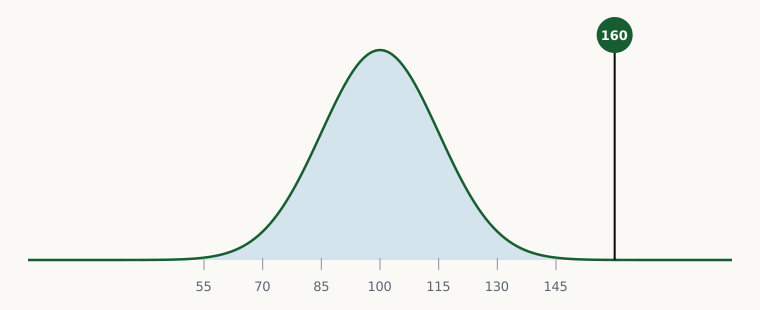
On a theoretical mean-100, SD-15 normal model, IQ 160 is 4.00 standard deviations above the mean, approximately the 100.00th percentile, and about 1 in 31,574 at or above. That calculation does not authenticate a score or replace the test publisher’s norms.
The score, percentile, and rarity remain visible while statistical landmarks and famous claims enter the story.
IQ alone cannot diagnose intellectual disability. Adaptive functioning, developmental history, test validity, and professional assessment all matter.
A score near 70 is often discussed in diagnostic contexts, but a number by itself is not sufficient for diagnosis or support decisions.
Search intent: 70 IQOn the mean-100, SD-15 model, about 16 percent of the population falls at or below this point.
Search intent: 85 IQModern IQ scales are commonly centered on 100. It is a standardized midpoint, not a percentage correct.
Search intent: average IQAn IQ of 110 is higher than roughly three quarters of the modeled population on an SD-15 scale.
Search intent: is 110 IQ goodThis is a useful statistical landmark: about 16 percent of the modeled population is at or above it.
Search intent: 115 IQIt is clearly above the model average. Descriptive labels vary between tests and should not be treated as universal categories.
Search intent: 120 IQAn IQ of 125 is statistically uncommon, but a real score still carries measurement error and test-specific norms.
Search intent: 125 IQOften described as gifted or very superior, although labels and eligibility rules differ. The upper-tail model is about 1 in 44.
Search intent: 130 IQ percentileAt this point small measurement differences can produce large-looking rarity changes. Test ceilings and confidence intervals matter.
Search intent: 140 IQThis is about 1 in 741 at or above under the model. Extra decimal places should not be mistaken for test precision.
Search intent: 145 IQUnder the mean-100, SD-15 model, IQ 150 is about 1 in 2,331 at or above. At this extreme, test ceilings, confidence intervals, and instrument differences matter more than extra decimal places.
Search intent: 150 IQNo verified Einstein IQ test record exists. The number belongs on the scale as a disputed public claim, not as his measured score.
Search intent: Einstein IQTest ceilings, measurement error, incompatible scales, and unsupported public claims make precision beyond this point especially unreliable.
Four standard deviations above the mean is extreme on this model. Pop-culture “genius = 160” is not a test publisher’s rule.
No verified Einstein IQ test record exists. The number belongs on the scale as a disputed public claim, not as his measured score.
On this model, 160 is four standard deviations above 100—about the 99.997th percentile, rarer than 130 (about 1 in 44) and 140 (about 1 in 261). Explore IQ 160 on the interactive bell curve. Nobody in this person atlas has a verified administered 160.
Einstein is commonly assigned 160. That is a disputed public claim, not a score report. See the Einstein investigation and why the internet says genius = 160.
| IQ | Approx. percentile | Directional rarity |
|---|---|---|
| 100 | 50.00th | about 1 in 2.0 at or above |
| 150 | 99.96th | about 1 in 2,331 at or above |
| 160 | 100.00th | about 1 in 31,574 at or above |
Age-normed scores, including a typical 12-year-old, still center near 100. See average IQ by age and the IQ percentile calculator.
The percentile shown here comes from a smooth normal distribution. A real assessment is normed for a particular test edition, age group, and reference sample. Its score report may provide a different rounded percentile and a confidence interval.
At high scores, apparent precision becomes especially misleading. Test ceilings, measurement error, practice effects, and differences between instruments matter more than extra decimal places.